New? Create an account


Enter your registered email address below to receive password reset instructions.

Please check your inbox and follow the password reset instructions.


Your account is ready to roll! 
Save your favorites and access them
anytime, anywhere, on any device.
Happy exploring!

Shopping cars within 250 mi of your nearest EchoPark.
656 S Military Hwy
Virginia Beach, VA 23464

Share this article
Published October 01, 2026
Share this article
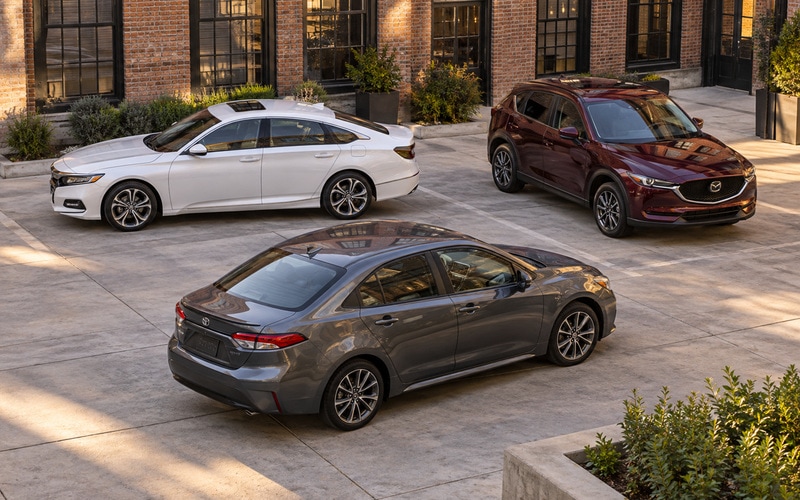
A sedan is a car body style with a three-box design. The engine, passenger cabin, and trunk each sit in their own section, and most sedans have four doors and seat five.
Sedans are known for a comfortable ride, good gas mileage, and a size that's easy to drive and park. They range from compact models built for city driving to full-size models with more room for passengers and cargo.
Sedans balance practicality, price, and comfort, which makes them a good fit for commuting, errands, and small families. This guide breaks down the types of sedans, how they compare to other body styles, and what to look for when shopping for a used sedan.
The table below compares common sedan classes by size, seating, fuel economy, and best use. Size classes follow the EPA's definitions, which group cars by combined passenger and cargo volume.
| Sedan Type | EPA Size Class | Seating | Fuel Economy | Best For |
|---|---|---|---|---|
| Compact Sedan | 100-109 cubic feet | 5 | Higher mpg, often 30+ combined | City driving, commuting, first-time buyers |
| Midsize Sedan | 110-119 cubic feet | 5 | Balanced mpg, often 25-35 combined | Families, daily drivers, comfort seekers |
| Full-Size Sedan | 120+ cubic feet | 5-6 | Lower mpg, more engine options | Passenger space, long-distance comfort |
| Luxury Sedan | Varies by model | 5 | Varies, often lower due to performance | Upscale features, refined ride quality |
| Hybrid Sedan | Varies by model | 5 | Highest mpg, often 40+ combined | Fuel savings, lower emissions |
A sedan is defined by its three-box shape, with the engine, cabin, and trunk in three separate sections. That's different from a hatchback, which combines the cabin and cargo area, and from an SUV, which has a taller, boxier build with shared rear cargo space.
Sedans typically have four doors, a fixed roof, and a trunk that's closed off from the cabin. That helps keep road noise and cargo smells out of the passenger area.
Most sedans also sit lower to the ground than SUVs or trucks, which helps with a smoother ride and more responsive handling. That lower center of gravity is one reason sedans feel stable at highway speeds and in turns.
Sedans are generally grouped by size and purpose, and each type fits a different kind of driver. Knowing the differences makes it easier to match a sedan to your budget, space needs, and driving habits.
Compact sedans are the smallest common class, with 100 to 109 cubic feet of passenger and cargo room under EPA guidelines. The Honda Civic and Toyota Corolla are well-known examples. They get good gas mileage and are easy to handle in city traffic and tight parking spots.
They're a common choice for first-time buyers, commuters, and anyone who wants a lower price and lower running costs.
Midsize sedans add more interior room and often more powerful engine options, while still getting solid gas mileage. The Honda Accord and Toyota Camry are well-known examples in this class.
Want more cabin and trunk space without moving up to a bigger vehicle? A midsize sedan is worth a look. Our Honda Accord vs. Civic comparison shows how a midsize and compact sedan stack up.
Full-size sedans put passenger space and ride comfort first, with longer wheelbases and roomier back seats. Many come with larger engines, which can mean lower gas mileage than compact or midsize models.
They suit buyers who care more about space and comfort on long trips than gas savings.
Luxury sedans focus on premium materials, advanced technology, and refined performance. They come in compact through full-size dimensions depending on the brand.
Thinking about a used luxury sedan? Weigh the higher potential cost of maintenance and repairs against the upgraded features and driving experience.
Hybrid and electric sedans use alternative powertrains to cut gas use or skip it entirely. The Hyundai Elantra Hybrid and Tesla Model 3 are two examples.
They're a good option for drivers with long commutes who want to lower fuel costs over time.
Sedans and SUVs differ mainly in body shape, ride height, and cargo setup. A sedan has a separate, enclosed trunk and sits lower. An SUV is taller, with a shared cabin and cargo area behind a rear hatch. That difference affects gas mileage, handling, and visibility.
Sedans generally get better gas mileage than similar-size SUVs because they're lighter and more aerodynamic. SUVs typically offer more cargo flexibility, a higher seating position, and available all-wheel drive or a third row in larger models.
The right choice comes down to whether you care more about efficiency and handling or space and versatility.
The main difference between a sedan and a hatchback is the trunk. A sedan has a separate trunk closed off from the cabin. A hatchback combines the cargo area and cabin behind a rear liftgate.
Hatchbacks often have more flexible cargo space, since the rear seats fold down to create a larger open area. Sedans keep cargo and passengers separate, which makes for a quieter ride and keeps items in the trunk out of sight.
Sedans offer a practical mix of gas mileage, comfort, and price. They sit lower and weigh less than SUVs and trucks, which typically means better gas mileage that adds up over years of ownership.
Sedans are also generally easier to park and drive in cities. Their four-door, five-seat layout works well for singles, couples, and small families.
Common reasons buyers choose a sedan include:
Focus on the right model years, mileage, and maintenance history instead of the newest model year you can find. Sedans like the Toyota Camry and Honda Accord have a long reputation for reliability. Check ratings from sources like Consumer Reports or J.D. Power for the exact model year, and see our guide to the most reliable sedans as you narrow your search.
Think about how you'll use the car day to day, too. A compact sedan built for commuting serves a different purpose than a full-size sedan meant for road trips.
Pay attention to interior condition, tire wear, and documented service history. A vehicle history report shows past accidents, ownership changes, and service records. Each EchoPark listing includes a full vehicle history report, so you can review a car's background before you visit.
Shopping for a used sedan at EchoPark starts with browsing inventory online by size, price, or features. EchoPark cars are listed with no-haggle transparent pricing that's typically up to $3,000 less than the competition.
Qualifying vehicles also pass through a 190-point quality inspection and road test before they're offered for sale. The inspection covers the road test itself, plus the exterior, interior, underhood, tires and wheels, brakes, and underbody and electrical systems.
Working within a budget? Get a trade-in offer on your current car to lower what you finance,1 or apply for financing online so you know your numbers before you visit.
If you get home and the sedan isn't the right fit, EchoPark's 7-day Happiness Guarantee lets you return it within 7 days or 250 miles, whichever comes first, for a refund of the purchase price.2
When you're ready to compare options, browse used sedans at EchoPark to see what's available near you.
A sedan is a car body style with a three-box design that puts the engine, cabin, and trunk in separate sections. It typically has four doors, seats five, and sits lower than an SUV. Sedans are known for good gas mileage, a comfortable ride, and easy handling.
A sedan typically has four doors and seats five. A coupe has two doors and often a more sloped roofline for a sportier look. Coupes usually have less rear-seat and cargo room, since the design puts style and performance ahead of passenger space.
Compact and midsize sedans generally cost less upfront than comparably equipped SUVs. They also tend to cost less to fuel over time, since they're lighter and more aerodynamic than taller SUVs.
Compact sedans are often a good choice for first-time drivers. They're smaller, cost less, and are easier to handle than larger vehicles. Good gas mileage and wide availability on the used market also make it easier to find a well-maintained one on a tighter budget.
Reliability varies by model and model year, so check ratings from sources like Consumer Reports or J.D. Power before choosing a used sedan. Compact and midsize sedans from brands with a long track record of dependable engines and transmissions tend to hold up well with proper maintenance.
Most sedans seat five, with two in front and three across the back, though middle-seat comfort varies by model. Full-size sedans sometimes have a little more shoulder room in back, which helps taller passengers or three-across seating on longer trips.
A sedan has a low, three-box design with a separate trunk. A crossover is taller, with a shared cabin and cargo area like an SUV, but it's built on a car-based platform. Crossovers typically offer more cargo flexibility and a higher seating position, while sedans generally get better gas mileage and handle with a lower center of gravity.
Resale value depends more on the specific model, mileage, and maintenance history than on the sedan body style. Sedans with long reliability reputations, like the Toyota Camry and Honda Accord, tend to hold value better because demand for them stays steady on the used market.
1 Offer is valid for 7 days or 500 miles, whichever comes first. Get an extra $500 when you sell your car to EchoPark within 48 hours of receiving your offer. Car must be in the same condition as when the offer was made.
2 Return the vehicle to EchoPark in the same condition within 7 days or 250 miles, whichever comes first, for a refund of the purchase price.